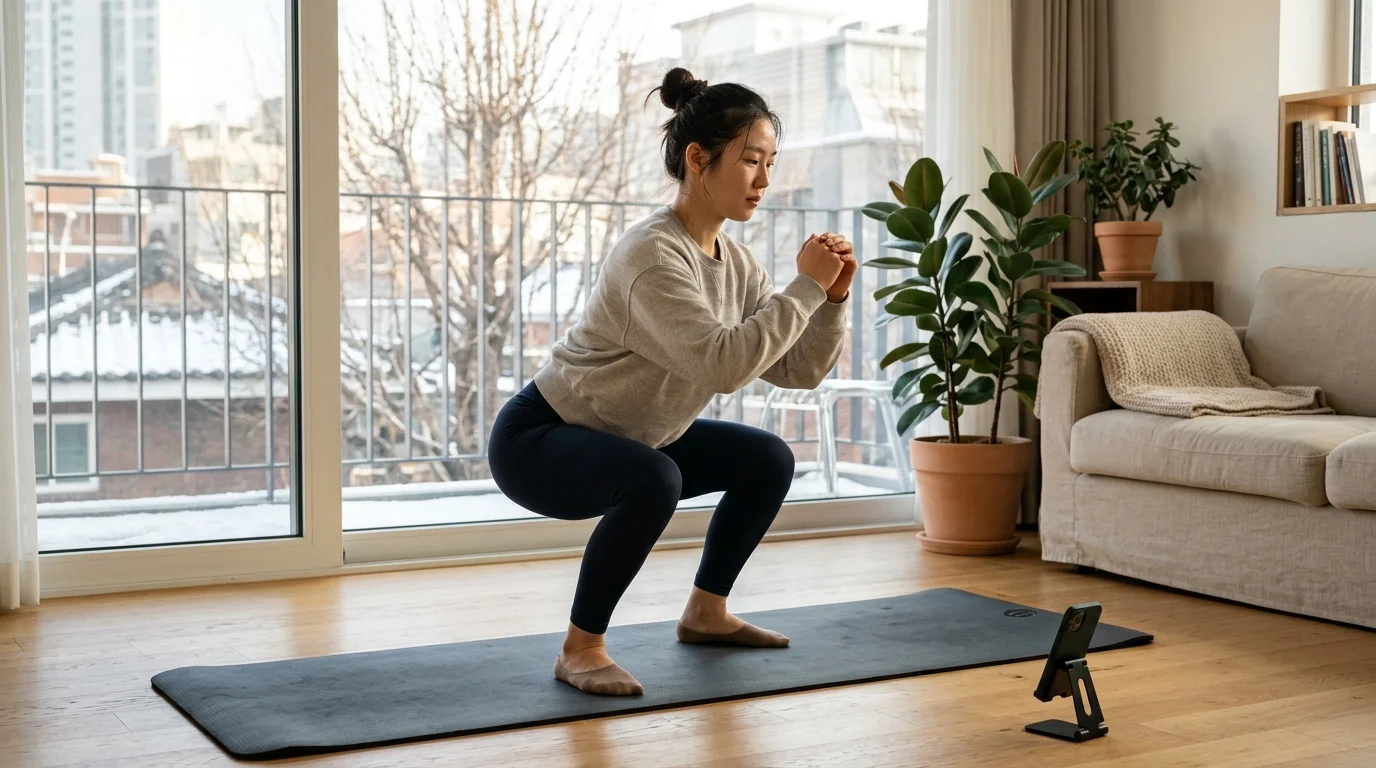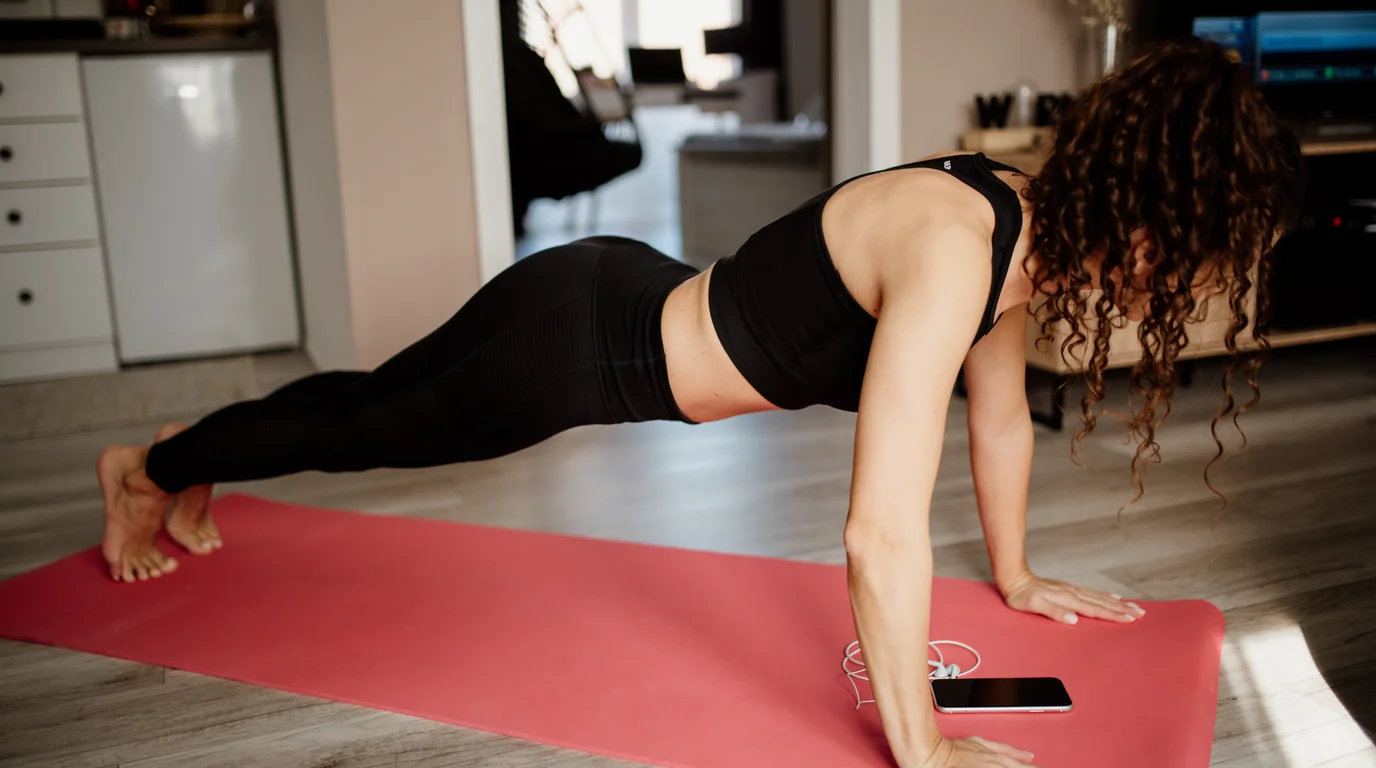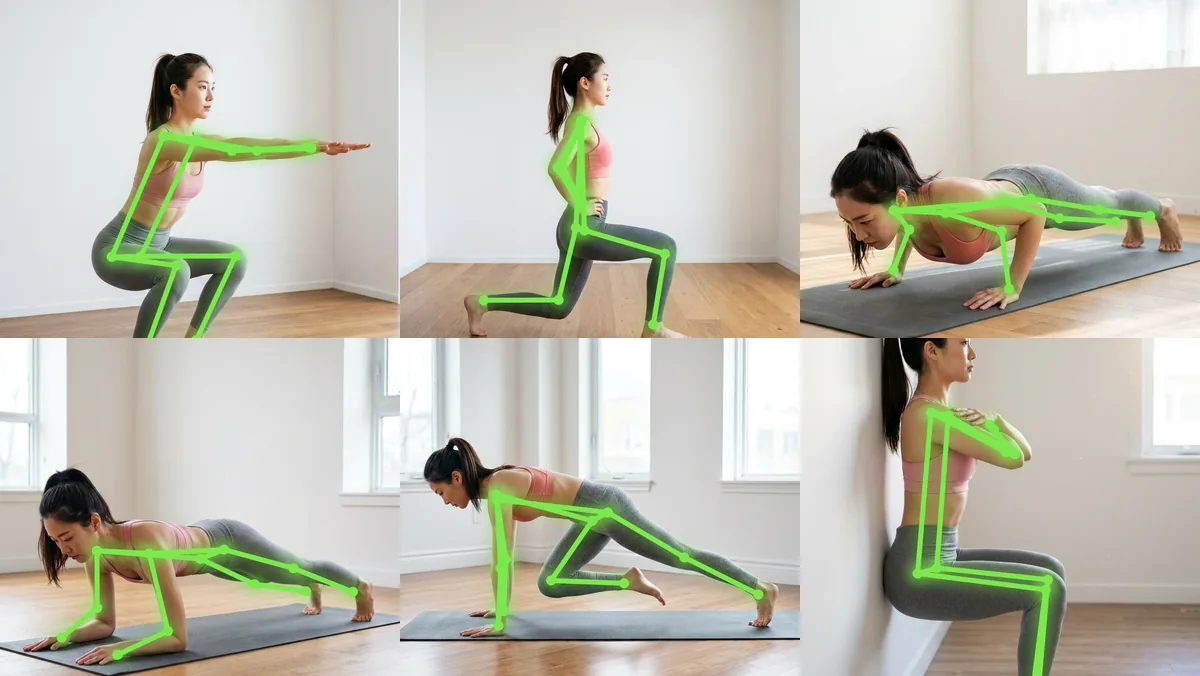
Here are all 10 bodyweight exercises that Fit Play counts automatically. The green lines on each photo are the joint positions the app actually read when ML Kit pose detection was run on the sample photo.
Tap an exercise to see step-by-step form photos, benefits, and instructions, along with exactly which movement Fit Play counts as one rep.
Legs (3)
Squat
The fundamental lower-body movement. Sit your hips back and down until your thighs are near parallel, then drive back up to standing. One stand → squat → stand cycle counts as a rep.
Lunge
A single-leg strength move. Step into a split stance and drop your back knee toward the floor, then return to standing. Great for balance and unilateral leg strength.
Wall Sit
An isometric leg hold — the 'invisible chair.' Slide your back down a wall until your thighs are parallel to the floor and hold. The timer runs while you stay in the seat.
Upper Body (1)
Push-up
An upper-body press: lower your chest toward the floor with elbows tracking back, then push away. One full down-and-up counts as a rep.
Full Body (2)
Slow Burpee
A no-jump, apartment-friendly burpee: squat down, step back into a plank one foot at a time, step forward, and stand tall — all at a controlled tempo. Full-body work without noise or impact. Each full stand→plank→stand cycle counts as a rep.
Mountain Climber
A dynamic plank drill. Hold a strong plank and drive one knee toward your chest, then switch. Each knee drive and return counts as a rep.
Core (4)
Sit-up
A classic ab exercise. From lying flat, curl your whole torso up toward your knees, then lower back down with control. One lie → up → lie cycle is a rep.
Crunch
A smaller, focused sit-up: lift only the shoulders off the floor while the lower back stays down. Targets the upper abs with less strain on the spine.
Leg Raise
A lower-ab move. Lying flat with straight legs, raise them toward vertical, then lower without touching down. Keep the knees straight throughout.
Plank
An isometric hold: support your body in a straight line on your hands or forearms and hold. The timer runs while the plank line stays true; it pauses if your hips sag or pike.
Every exercise is a no-jump bodyweight move, so you can do them quietly at home. Run them as a routine in Fit Play and the reps and rest periods take care of themselves.
Structuring Weekly Bodyweight Training at Home
To maximize metabolic output and muscular balance without gym equipment, pair one lower-body push movement (Squat, Lunge, or Wall Sit), one upper-body push movement (Push-Up), and one core or conditioning movement (Plank, Crunch, Leg Raise, Mountain Climber, or Slow Burpee) into a 3-round circuit three to four days per week.
Because camera-based angle thresholds prevent shallow half-reps from being counted, focusing on controlled 2-second eccentric lowering yields better joint safety and muscle recruitment than rushing for speed.