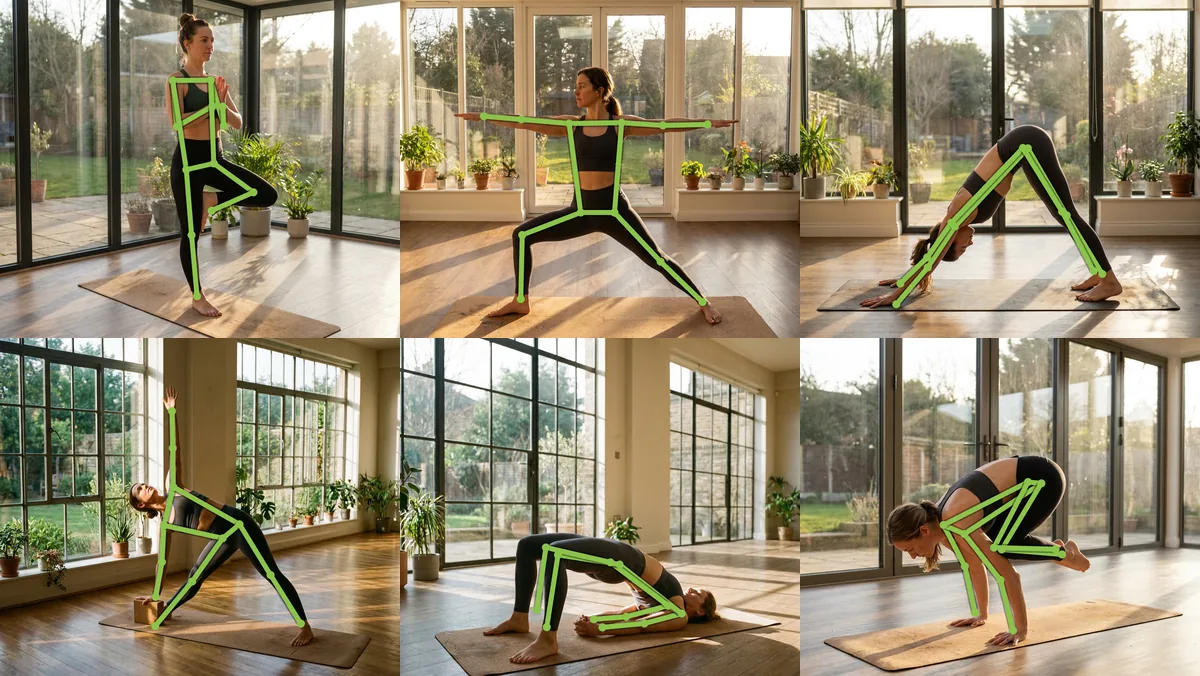
Here are all 26 yoga poses in Yoga Play in one place. The green lines on each photo are not drawn by hand: they are the joint positions the app actually read when ML Kit pose detection was run on the sample photo.
Tap a pose to see its steps, breathing, benefits, and cautions, along with the rules Yoga Play uses to recognize it.
Beginner poses (15)
Easy Pose (Sukhasana)
A comfortable cross-legged seat for settling the breath and mind. Ideal to open and close any practice.
Mountain Pose (Tadasana)
The foundation for all standing poses, aligning the body from soles to crown.
Cow Pose (Bitilasana)
From all fours, drop the belly and lift the chest and gaze to gently arch the spine.
Cat Pose (Marjaryasana)
From all fours, round the back and drop the gaze to the navel to stretch the spine.
Downward Dog (Adho Mukha Svanasana)
An inverted V shape that stretches the whole body, opening the hamstrings and shoulders.
Upward Dog (Urdhva Mukha Svanasana)
A backbend that lifts the chest and strengthens the back for an upright posture.
Cobra Pose (Bhujangasana)
A beginner backbend that gently lifts the upper body from a face-down position.
Child's Pose (Balasana)
A resting pose that folds the torso forward over kneeling legs to release the whole body.
Warrior I (Virabhadrasana I)
A standing pose with a bent front knee and arms overhead that works the whole body.
Warrior II (Virabhadrasana II)
A wide-legged standing pose with arms reaching out to build lower-body endurance.
Tree Pose (Vrksasana)
A classic balancing pose on one foot.
Chair Pose (Utkatasana)
A pose like sitting into a chair that works the thighs and glutes.
Seated Forward Bend (Paschimottanasana)
A calming forward fold over extended legs while seated.
Bridge Pose (Setu Bandhasana)
A gentle backbend that lifts the hips and opens the chest from lying down.
Corpse Pose (Savasana)
A final relaxation pose lying down to fully release all tension.
Intermediate poses (8)
Triangle Pose (Trikonasana)
A wide-legged side bend that stretches the side body and legs.
Plow Pose (Halasana)
An inversion that takes the legs over the head, deeply lengthening the spine.
Pigeon Pose (Eka Pada Rajakapotasana)
A deep hip opener with one leg folded forward and the other extended back.
Boat Pose (Navasana)
A seated V shape that lifts the torso and legs to strengthen the core.
Camel Pose (Ustrasana)
A kneeling backbend that opens the chest and belly broadly.
Bow Pose (Dhanurasana)
A face-down backbend holding the ankles to lift the body like a bow.
Extended Side Angle (Utthita Parsvakonasana)
From Warrior II, a side bend forming a long diagonal from foot to fingertips.
Half Moon Pose (Ardha Chandrasana)
A balancing pose on one hand and one foot, opening the body to the side.
Advanced poses (3)
Crow Pose (Bakasana)
An arm balance lifting the body with knees resting on the upper arms.
Headstand (Sirsasana)
An advanced inversion supporting the body on the head and forearms.
Handstand (Adho Mukha Vrksasana)
The most challenging balance, stacking the body into one vertical line on the hands.
Found a pose you like? Try it in Yoga Play. Your hold time is logged only while the camera recognizes the pose.
How to Build a Balanced Home Yoga Session
Rather than attempting advanced inversions right away, an effective 15-to-20-minute home yoga practice follows a gradual warm-up arc: start with grounded spinal mobility (Easy Pose, Cat-Cow), progress to standing alignment and hip stability (Mountain, Warrior I & II, Triangle), open the chest and hip flexors (Cobra, Bridge, Pigeon), and close with restorative nervous-system down-regulation (Child’s Pose, Corpse Pose).
When practicing with camera-based pose tracking, place your phone two to three steps away at waist or floor level so your shoulders, hips, knees, and ankles remain clearly visible inside the frame without backlighting.